Catacombs Paris TicketsTickets & Tours
Paris · History & visitor context

Paris Catacombs History & Visitor Information

The Paris Catacombs are more than bone-lined walls. They began as limestone quarries, became a municipal ossuary in 1786, and were reshaped as a public memorial in the early nineteenth century. Learn the people, changes and details that explain the route underground.

What it isAn ossuary in former quarries
Consecrated7 April 1786
Public visits began1809
Public routeAbout 20 metres underground
Origins

Why Paris made room underground

The route makes sense when you see the quarry first. The ossuary was fitted into an existing industrial landscape.

01Before 1785

Limestone came before the bones

The public circuit runs through former Tombe-Issoire quarries. Workers had removed limestone here long before the space gained a funerary purpose.

Why this mattersRough walls, supports and narrow passages belong to the quarry, not to a purpose-built cemetery.
021785–1787

A public-health problem changed its use

Overcrowded Paris cemeteries led authorities to transfer remains underground. Charles Axel Guillaumot, quarry inspector, prepared the site and organised the early work.

Look at the transitionThe formal ossuary begins inside a working landscape that had already existed for centuries.
!
The Catacombs are not natural caves

They are former limestone quarries adapted for an ossuary. Nor do the remains come from one event or one period; they were transferred from several Paris cemeteries.

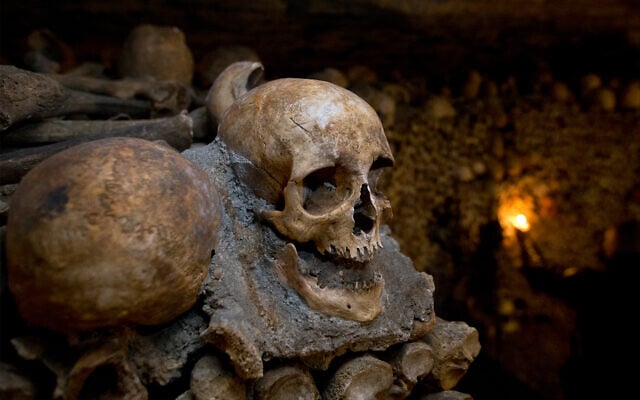
Stone passage and bone-lined walls underground
A quarry made into a memorial The contrast between rough stone and ordered bone façades reflects two different uses of the same underground space.
How it changed

Seven decisions shaped the route

The Catacombs were not made in one campaign. Each phase changed how Paris used, presented or protected this underground place.

011785–1787

Transfers create an ossuary

Authorities moved remains from Paris cemeteries into the former quarries. The site was consecrated as the Paris Municipal Ossuary on 7 April 1786.

What remainsThe route still joins quarry galleries to the burial space created by these transfers.
021809

Visitors enter by appointment

The ossuary opened to the public by appointment. It was no longer only a municipal solution to cemetery overcrowding.

Important distinctionPublic access came after the transfers had begun, not before.
031810–1814

Héricart de Thury creates a monument

Inspector Héricart de Thury rearranged the ossuary with bone walls, plaques and monuments. He turned stored remains into a planned place of reflection.

What to noticeThe regular skull rows and long-bone bands are deliberate façades, not random piles.
041840s

Further cemetery transfers continue

Additional remains entered the ossuary during the nineteenth century. The memorial represents many cemetery clearances and many periods of Paris life.

Visitor takeawayThe bones do not belong only to the French Revolution.
051859–1860

Redevelopment brings more transfers

Urban redevelopment brought further transfers of remains. Paris above ground was changing quickly, and the underground ossuary absorbed part of that change.

What remainsCemetery plaques connect the underground displays to the city’s former burial grounds.
062017–2019

The visitor route gains new arrival points

A new exit and shop opened in 2017. The entrance pavilion was restored in 2019, improving the modern visit without changing the underground monument’s purpose.

What to noticeThe route remains one-way, which preserves the feeling of moving through successive layers.
072025–2026

Renovation resets the visitor experience

The Catacombs closed on 3 November 2025 and reopened on 8 April 2026. Works updated conservation systems, lighting, safety and interpretation.

What changedThe renewed route adds a new audio experience while keeping the authorised circuit underground.
Craft

Quarry workers shaped the setting

The Port-Mahon sculptures, linked to quarry worker François Décure, recall the site’s working life before it became an ossuary.

Meaning

Order gives the bones a message

Héricart de Thury used plaques, monuments and patterns to frame the ossuary as a memorial rather than a storage space.

Current use

A controlled public circuit

Visitors see a 1.5 km authorised route. It is not access to the wider network of closed quarry tunnels.

Five dates worth remembering before you visit

You do not need every detail. These dates explain why the route shifts from quarry to ossuary, then from storage space to public monument.

  1. 1786: The Paris Municipal Ossuary is consecrated, making former quarry galleries a burial site.
  2. 1809: Public visits by appointment begin, giving the underground space a new audience.
  3. 1810–1814: Héricart de Thury creates the ordered displays and monuments visitors recognise today.
  4. 2019: The entrance pavilion is restored, updating the approach to the historic circuit.
  5. 2026: The Catacombs reopen on 8 April after major renovation work.
Architecture & meaning

A quarry route with a memorial inside it

The route’s form follows what was already underground. Later decoration gives that practical space a solemn public meaning.

How the building works

Passages first, ossuary later

The circuit descends into limestone galleries before reaching the remains. The quarry structure sets the scale, surfaces and turns of the route.

  • Rough limestone walls from the former quarries
  • Supports and passages built for underground work
  • The shift from plain galleries to formal façades
Why the imagery matters

A civic memorial, not a spectacle

The displays use repetition, inscriptions and monuments to ask visitors to reflect on mortality and the city’s buried past.

  • Skulls and long bones arranged as a visible front
  • Plaques naming cemetery transfers and historical context
  • Real remains preserved within an authorised visitor route

The walls are not the whole ossuary

The neat bone façades are the front of a deeper arrangement. Looking only for skulls misses the nineteenth-century decision to make storage look like a monumental memorial.

Pause at the change in stone, lighting and order. That transition tells the story more clearly than one photograph does.

The Catacombs are not a map of all underground Paris

The public circuit occupies a small authorised part of a much wider former quarry network. The route is designed for a one-way visit, not free exploration.

What to notice

Read the route as a sequence

The underground space can feel overwhelming. Follow a short list instead of trying to study every wall.

1. The first rough walls

They belong to the former quarry and explain why the ossuary could exist underground at all.

2. The change into the ossuary

Notice when plain quarry passages give way to ordered displays and memorial language.

3. Repeated skull rows

They show Héricart de Thury’s early nineteenth-century effort to turn remains into formal façades.

4. Cemetery plaques

These link the underground site to burial grounds that once stood above ground across Paris.

5. The Port-Mahon sculptures

They point back to quarry workers and the underground site’s industrial life before the ossuary.

6. The Crypt of the Passion

Its deliberate cylindrical form shows that some bone arrangements were designed as monuments, not simple storage.

Ready to visit

Look at the Catacombs as layers of history, not one famous room

Start with the quarry walls, then watch for the formal entrance to the ossuary. Read one plaque, study one arranged façade, and finish with the monuments. That order reveals how a working underground space became Paris’s collective memorial.